
LETTER FROM TANGIER: 7/24/25
VILLA MABROUKA, THE ART OF FRIENDSHIP, ANOTHER MOHAMMED, A FEW MORE CHERRIES FROM THAT ORCHARD, and BARRY DILLER'S BOOK

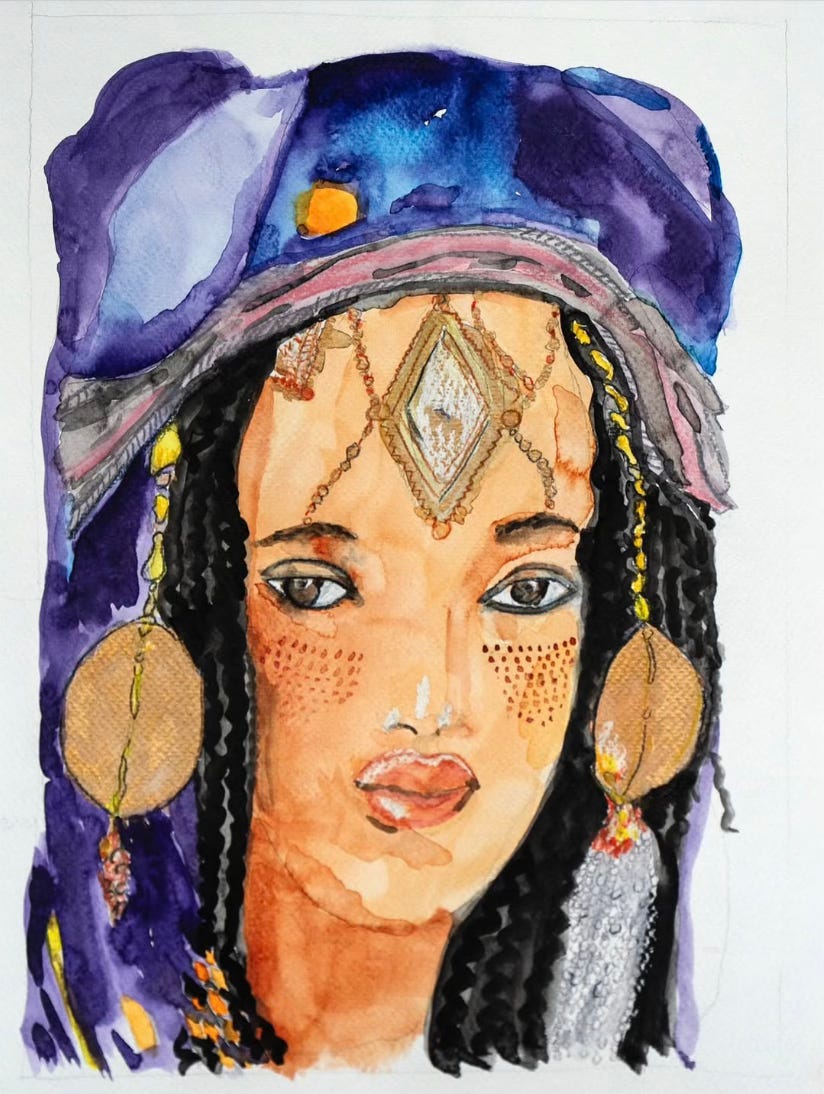
“You need to say it better. Differently. Softly.”
- Madame Ranyevskaya to Trofimov in Andrew Upton’s translation of
Anton Chekhov’s “The Cherry Orchard”
1.
The above water color portrait titled Fadima was imagined by Johnny Rozsa for his exhibition of portraits at the Gallery Kent here in Tangier. It opened a couple of weeks ago as part of group show, Compass Point, and runs until September 10th. I not only found the array of faces aesthetically moving but also what underlay them. I sensed the unspoken narratives that Johnny, a renowned photographer, seemed to have been instinctively, even lovingly, conjuring for them as they emerged simultaneously from his brush. Each narrative of each named portrait then filtered through our viewing of them and became the ones we too saw there. All these narratives, a storied community, were able to nest there within these portraits along with his. It reminded me of my definition of a successful memoir: you know you’ve written one when readers see their own lives in them and not just yours. John Keats, one of my favorite poets, called it negative capability. Others of us - there it is again, we, the others - call it empathy.
Other narratives.
The narrative of the other.
I’ve been thinking a lot about that this past week.
Maybe it is just the writer in me, but when I first came upon these portraits by my new friend Johnny they all seemed haunted with their many stories as much as imbued with the colors that hew to Morocco’s hued history that saturate so much here - merchandise, your meanders in the Medina, wardrobes, the horizon and the hills, even the striated coats of the myriad stray cats that can’t camouflage their being by now after so many littered generations of the poor damn things lolling about as much Moroccan as they are feline, four-legged, dependent, underfoot, indignant about having been not quite domesticated but discarded. We who respond to Tangier in its allowing us not to be quite domesticated here after discarding so much of the rest of the world for its having discarded us become Moroccan cats ourselves - to use some jazz jargon, the kind of music you often encounter wafting about. We are helpless to resist this city’s odd, dueling syncopation of calls to prayer amidst that first hissed syllable of sinister (a word for something itself that lolls catlike and coiled here underfoot) as well as transactions gone loudly south (the swelling, rhythmic hum of the augmentative augmented by the nag of sweetness, a daring chord of it, a diminished 7th, always there nudging you with it along) and the truer north of silently keeping time and nodding in agreement at what you can’t understand, not really, not ever, because knowing you will never really understand is all the knowledge you ever really need. “Come on, man, all else - dig - is narrative,” as we cats say straying from an earlier life by living the one that brought us here, we others in this city’s defiant otherness, and ours. Yep. There is a moment of being here when living here takes hold like that other moment you realized you actually liked jazz after years of trying to listen to the stuff.
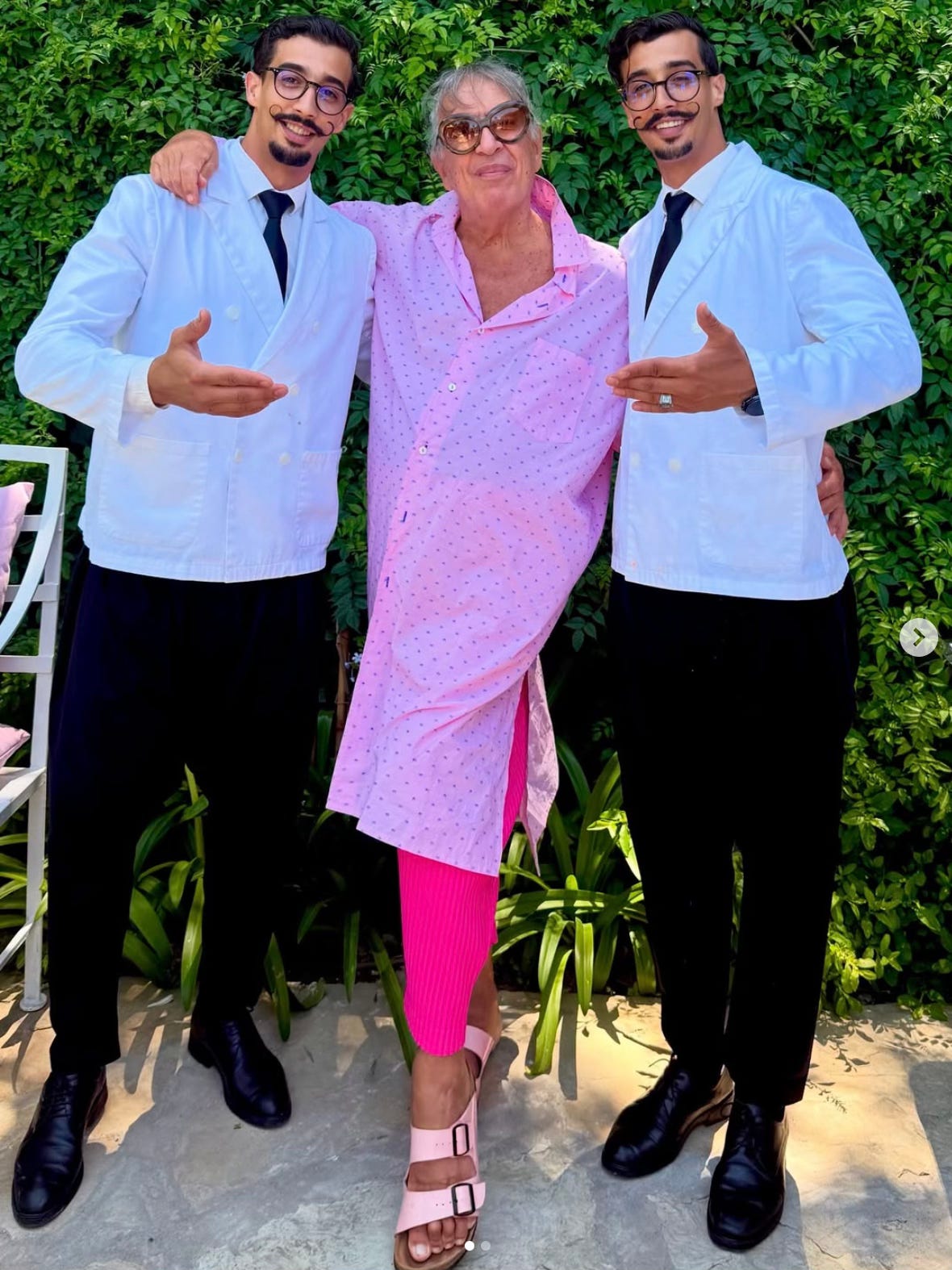
That's Johnny above between Hassan and his brother, Soufian, whose sameness makes them other, different. I’ve nicknamed them Salvador and Dalí. They are my favorite waiters at Villa Mabrouka which once was the home of Yves Saint Laurent and has now been reconfigured into a beautiful hotel and restaurant and bar owned by Jasper Conran. I was touched to have been invited by Johnny to his art show’s opening night dinner there thrown by Jasper in a private dining room. I was eyeing one of these brothers that night when he walked over to me to acknowledge my noticing him. “There’s another me,” he whispered then showed me a photo of his twin. “This is the other.”
I went back to Mabrouka on Wednesday to try out a pizza from its new pizza oven and to notice both these young men yet again. One. Then the other. Or maybe it was the other way around. They came over to say hello and to visit a bit. But I discovered that the pizza oven is only open on Friday and Saturday and Sunday nights. So I had the Chicken Tanjia and some spinach and listened to the wafting sounds of Dinah Washington and Louis Armstrong and Ella Fitzgerald and Sarah Vaughn being piped into the place. I nodded, keeping time, but always have guilt about spending money at such a restaurant because it can break my budget a bit. I’d rather save the money and spend it on the ballet or a night at the theatre. I wish I had it to spend on one of Johnny’s paintings but then I, a pilgrim, don’t have a wall to put it on.
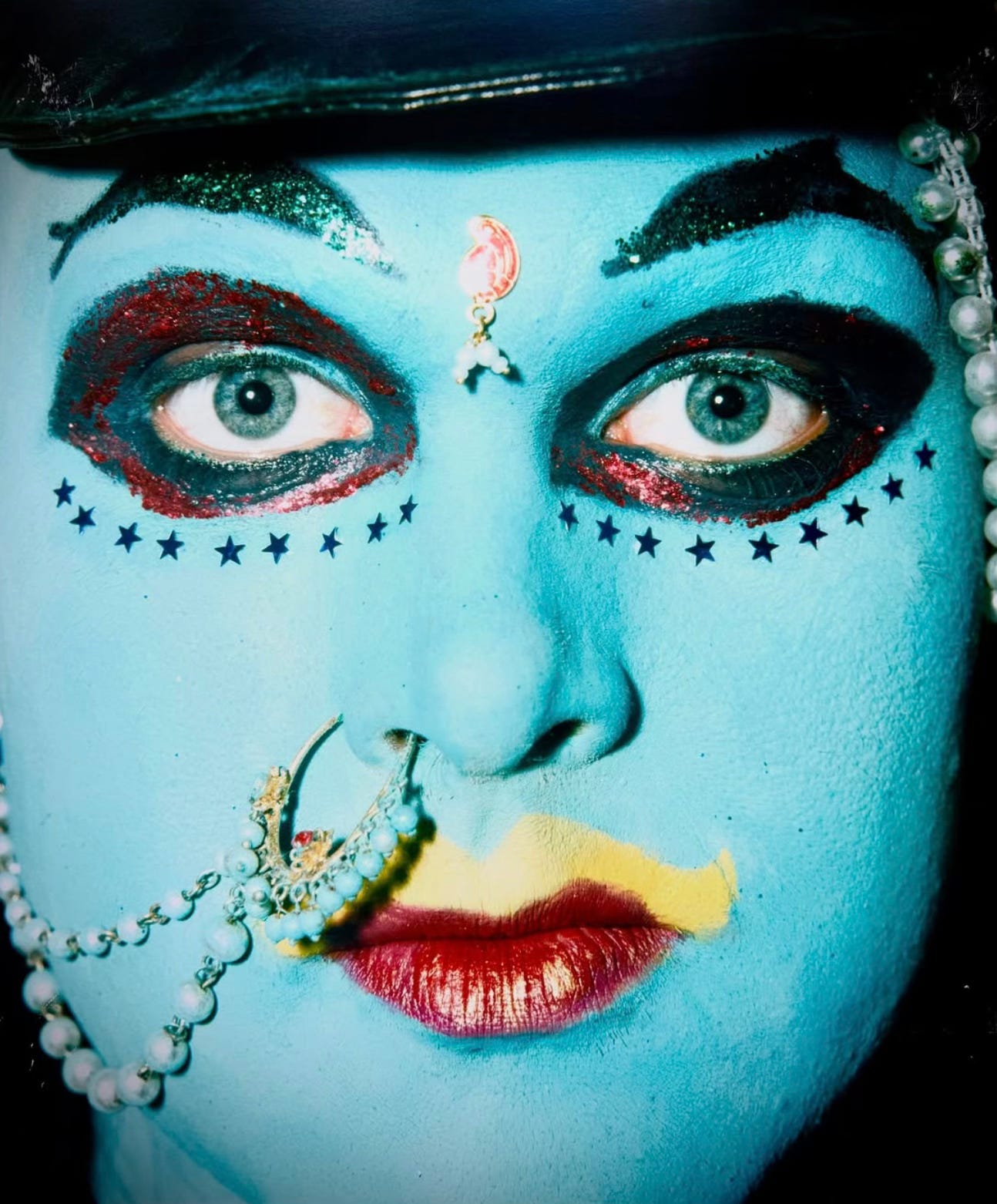
When I was first looking at his work at Gallery Kent - I’ve been back a couple other times to stroll through it all and let it tell me some more stories - I was reminded of this photo above he took of Leigh Bowery, a cat of another color. I had seen it on Johnny’s Instagram page. The Tate Modern exhibit based on Bowery’s life runs until the end of August. He and Johnny were also friends. If you’re in London, don’t miss it.
2.
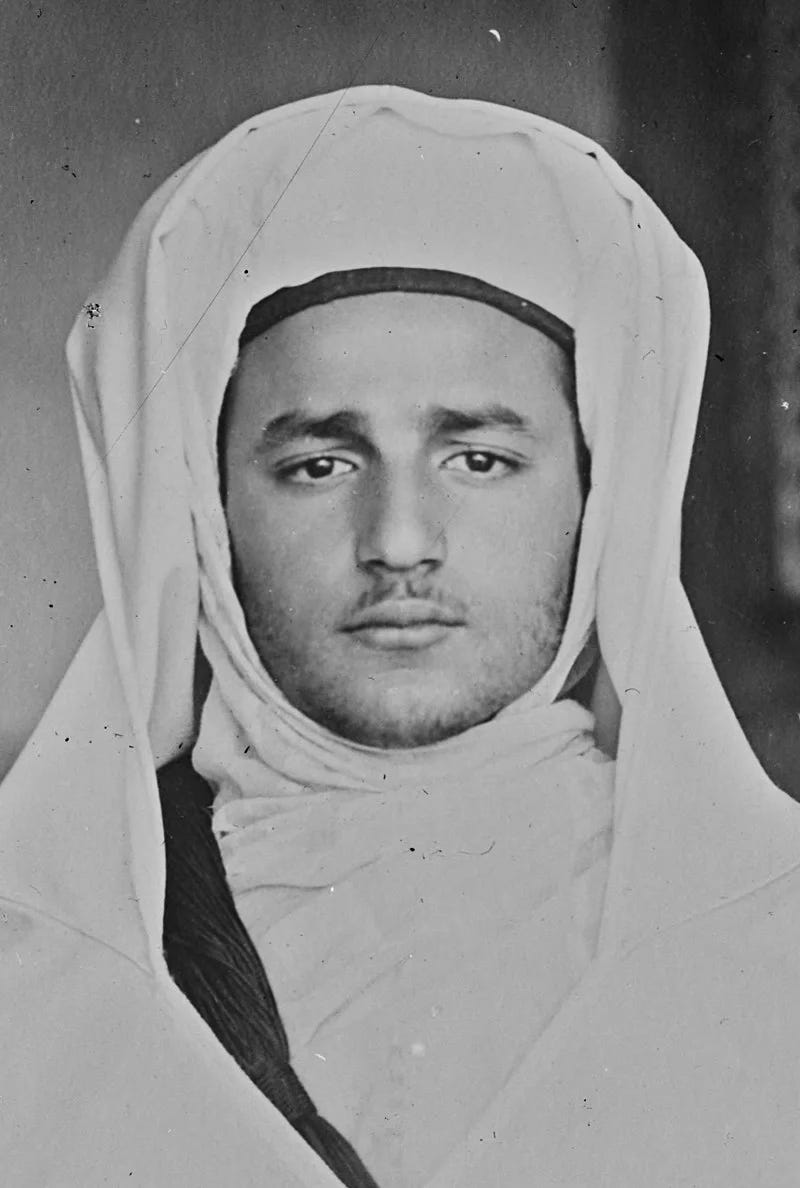
Part of Morocco’s history that hews to this theme of otherness concerns the country’s ruler in the 1940s, Mohammed V (Mohammed ben Youssef), and his defense of his country’s Jewish population - its others - in defiance of the Vichy French who demanded they be turned over to them. He - the country’s last sultan and its first king - refused to do so and saved the 250,000 Jewish Moroccans from being shipped off to Nazi death camps. Although antiSemitism existed - and exists - in Morocco, the Jewish population was allied with the ruling Alaouite dynasty. Mohammed V was reported to have stated both rightly and wrongly: “There are no Jews in Morocco. There are only Moroccan subjects.”
The ones.
Then the others.
There is a fascinating story about all this by Theo Zanou in Smithsonian Magazine.
3.
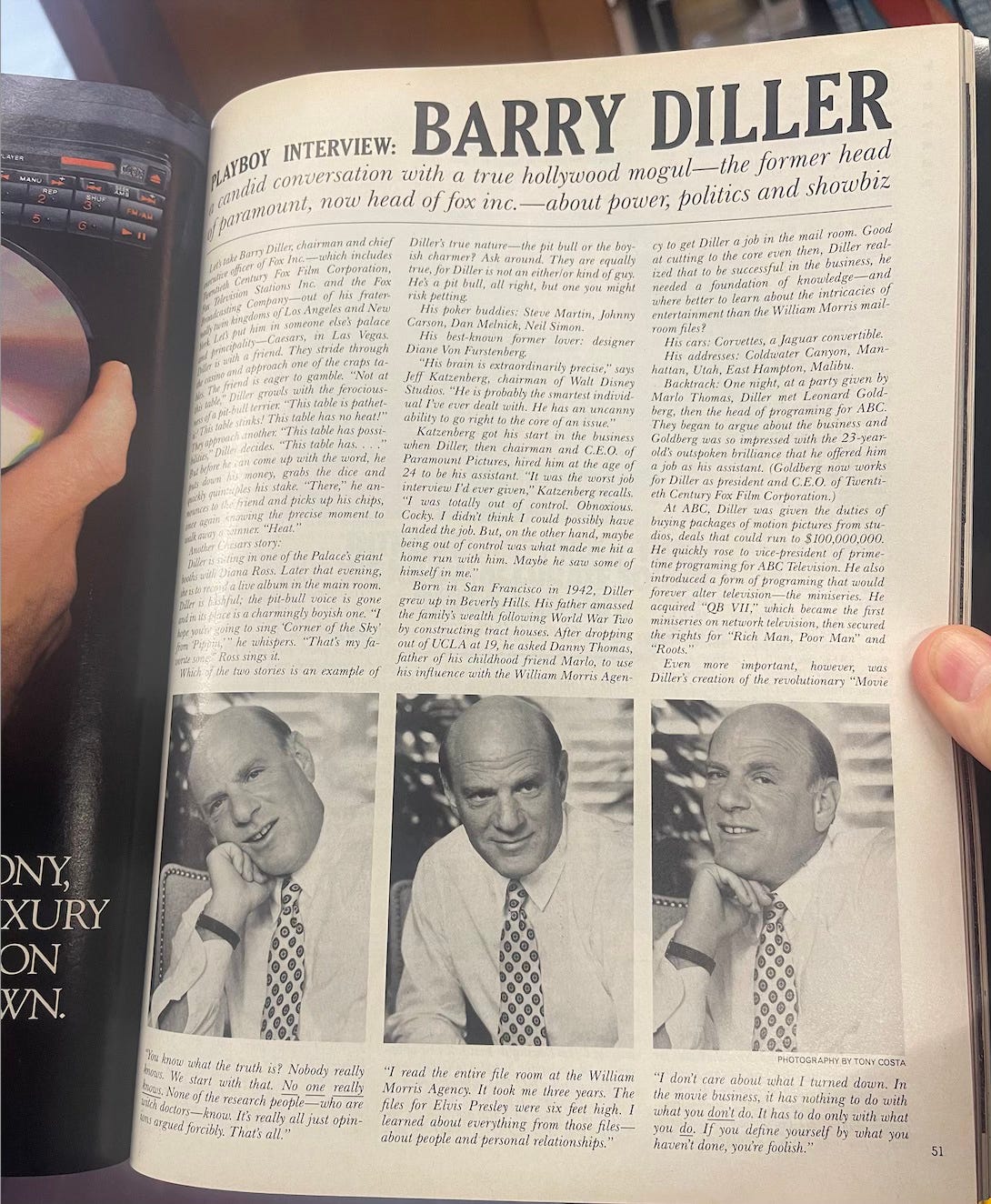
That is the opening page above for the Playboy Interview with Barry Diller. It ran in the July 1989 issue. I conducted it while I was still the Executive Editor of Andy Wahrol’s Interview and wrote the intro. That intro, in fact, got me my job at Vanity Fair as did Barry’s having said yes to me because he had kept saying no to Tina Brown at VF about a story on him in there - although now they are close friends who admire and love each other. There have been lots of yeses since. He even created The Daily Beast for her as part of his digital empire so she could continue to conjure The Beast originally in her own distinctive way. I worked for her there as well. Conjuring the beast - even as I typed that it had the ring of what we creative media types do with the help of business titans like Barry with their own creative moxie. Substack is less beast-like, but Lord the conjuring that goes on within its construct.
Like Tina, I’ve long admired and, yes, loved Barry. I’ll confess here that we even had a bit of a flirt at one point that was almost consummated. I think we each were a bit confused by it but what I wasn’t confused about was knowing that it would always be just a flirt because his truest and deepest love was and always will be for Diane von Furstenberg and her children. He has worked and worked and built and built businesses and empires and a fortune with the force of his will and the help from time to time from the serendipitous. But they - DVF and her children and now theirs - are his one miracle. There was nothing willful about that. It was instead about surrender and acceptance and grace. For once he had to stand aside and allow it all in. Allow himself to be loved. I am grateful that we developed a kind of friendship from that flirt that resulted from my doing that Playboy Interview which gave me a vantage point to continue to witness that miracle in his life and how it has helped him to heal, daily and with devotion. He and DVF gave me a dinner and party at Indochine when my first memoir Mississippi Sissy was published. They are kind people. It is Barry’s kindness and goodness that I admire about him even more than his business acumen. As I told him after beginning his recent memoir, Who Knew, I am glad that his innate sweetness no longer makes him break out in a cold sweat. God knows he owns a lot in his life. I am glad too he now owns that.
I worked at Paramount during the early and mid 1980s when he ran the place. I was an executive secretary for Buffy Shutt, an EVP of marketing and publicity, whose office and my desk were on the same executive floor at the Gulf+Western Building where Barry had the suite that befitted him. It was the era of Michael Graves furniture. There was a lot of it around on that floor. I saw my own life in his memoir during those Paramount years about which he wrote so vividly and insightfully. I might be one of the few of his readers who could come up with images of Art Barron and Donald Oresman, G+W executives, when he mentioned them - and feel a knowing smirk of a smile surfacing each time he did. Charles Bluhdorn, an acquisitive contraption of man who owned G+W, an acquisitive contraption of a corporation which bought Paramount in 1966, plucked Barry out of ABC where he had become a wunderkind, and gave him the job of Chairman and CEO at Paramount when Barry was still in his early 30s. Barry makes clear in this book his love and deep respect for Charlie. When Bluhdorn died at the age of 56 from a heart attack, all hell broke loose slowly but surely on that executive floor when an apparatchik named Marvin Davis, a henchman without a clue, took over in his stead. I had a front row seat at that desk of mine on that floor to watch it all happening because except for Barry and Buffy - and another Paramount person I liked a lot when she was in town from LA where she ran production, Dawn Steel - no one paid me much attention. I was the kid who wanted to be a writer who never seemed to file anything or figure out how to advance in any corporate sense. I was basically using my IBM Selectric to compose short stories between answering Buffy’s phone. I’d then send them to The New Yorker and an editor there, Linda Asher, who was encouraging me to keep writing them and sending them along. She also kept telling me I was a writer, confirming it. I will always be grateful to Linda and to Buffy and her own benign encouragement of my writing by letting all that filing slide and finding in her heart to keep me on as a secretary because I was a really bad one. Unlike Barry, who shows us in the book what a great assistant he was at the beginning of his career, I didn’t have that skill set, that kind of focus it takes to suss out someone else’s needs as a way to figure out your own. I was too busy finding the right sentence. Still am. I remember when a New York magazine story came out about the tsuris at Paramount after Bludhorn’s death. I was the only person at work early that morning when Micheal Eisner, who was then President of Paramount, telephoned Buffy to see if she had a copy of the story. She had called me to bring one in - she traveled in from Mt. Vernon each day - but she hadn’t arrived yet. So Michael, who was calling from a pay phone in Maine where he was vacationing, told me to read him the whole article, which I proceeded stutteringly to do as be kept putting the demanded coins into the thing. Just another of the early Zelig-like moments in my odd life of adjacency and observation (and magazine articles) which finally is the kind of life that all writers, if we’re lucky, get to lead. Barry would come by my desk to talk a bit sometime during my years there in my mid-20s and play with the rubber bands on my desk. I’d keep them in a little bowl just for him hoping to lure him in for some chitchat so I could notice eyebrows around us being raised, other voices lowered, and ears pricking up. People were so intimidated by him at Paramount but I always thought of him as the shy nice guy who would visit me from time to time and try to make small talk. We’ve known each other for almost 40 years in many different ways.
There is a whole backstory about how I got Barry to agree to do that interview in Playboy and some day I’ll write about it in one of these columns when it pertains to a theme I’m weaving into it. But I’m writing about otherness today as did Barry in his remarkable memoir. He writes beautifully and yet it all has the feel of sitting around with him and shooting the breeze as you try to keep up with his brilliance which is also innate and which he, not really educated in the academic sense, has developed with the same sense of purpose he brings to so many other areas of his life. The book, like Barry, is just great company. I’ll miss reading it and having it around here in Tangier because it was like having him at the table with me - not much of an occurrence anymore - but one the book made me miss. He’s a mensch, a lovely man with a lovely laugh that not only signals his amusement at some remark - he does adore a pointed remark - but a deeper bemusement at what he once might have bemoaned but now, past 80, just grins and bears. His growling days seem over. The growl was performative anyway. He has the power still to do good. So he does it. And travels around on a boat.
I read most of the book - the first one I read on the iPad I bought during my springtime sojourn in Portugal - sitting in my “reading corner” at Tangier’s Aux 3 Portes. I recommend the place on its sloping cliff overlooking the water as the perfect reading perch if you find yourself here. It was in that corner where I read about his dealing with his otherness as a gay youth who grew into the otherness of his bisexual adulthood - the one-and-then-the-other of it - and the rather shocking otherness embedded in his family life. I loved reading about his rise in the entertainment world and his many pivots in his career toward his billions and building not only an architectural wonder along the Hudson River designed by Frank Gehry to house his internet companies but also a little island jutting out into it which is a wonder of engineering and generosity, a rich man’s folly perhaps but one New York City is fortunate to have surrounded, anchored. He and DVF also have helped fund the continuing marvel of The High Line. I do wish he’d been a bit more critical in the book of Rupert Murdoch’s politics. Murdoch was another mentor of his when he hired Barry away from Paramount to run Fox Studios and backed him in his dream to create a new television network. But I kept thinking of Rupert as his equal instead of his mentor in that Fox section as I also kept waiting for him to write about the destructive influence that Fox News has had on America. His not having done so is in some way proof of his loyalty to friends and colleagues and those who mentored him along his career path and with whom he bonded when they lived up to his idea of honor and a certain code of ethics. Billionaires do tend to stick together for complicated reasons that are finally more tribal than political if they share that personal code amongst themselves. Or maybe it’s not that complicated. It’s just that simple: it’s a tribe - one with even more codes and customs to which the vast majority of us will never be privy no matter how many books we read about them.
I do hope Barry has many more years to conjure and do good and sail around the world with DVF and their family and friends and laugh with bemusement and maybe even write another book. He’s good at. After my nephew Jake read it, he texted me to “tell Barry his book is incredible … got my drive and juices flowing like nothing since the Phil Knight book, Shoe Dog.” My brother listened to the audio version while he was working on a sculpture in his studio and emailed me how moved he was by how open Barry had been about the difficulties of his early family life. It was a childhood of material privilege and emotional deprivation. There was a void there where damage was not exactly done to him but, undefined, simply settled in biding its time with nothing much to do. Who Knew is finally a book about a man finding a family. A place where he had so longed to settle in himself and replace the dull ache of the undefined with the deepness instead of a love that abides. It is that love that has, yes, come to define him. That is this memoir’s success story. It is his.
4.


Finding a family took up a lot of Chekhov’s writing too. As did tribalism. The dull ache of the undefined. A bemusement at what others bemoan. Often as well they are narratives about the one who turns out to be the other. Chekhov is one of my favorite writers and, as I mentioned last week, I was thrilled to be able to watch some of the dress rehearsal of his The Cherry Orchard and attend its lone charity performance the next night here in Tangier. That is one of the 200 fans that Johnny Rozsa hand-painted which were then placed at every seat along with a program before the play began. The second photo is of Gillian Anderson who played Ranyevskaya and Derek Jacobi who played Firs in the midst of the dress rehearsal. I’ve turned in a second draft of a piece I wrote for an outlet, highbrow but not haughty, about the evening and the rehearsal after taking an editor’s advice which mirrored Ranyevskaya’s to the student Trofimov when she told him to say it better and differently, more softly. I tried to find that balance which the outlet itself does. I am still waiting to see if and when it runs so again I’m being careful about what I write here about it.
It had been Kenneth Branagh’s idea to do The Cherry Orchard this summer for the charity event, its tenth anniversary, spearheaded by garden designer and writer Madison Cox and director Rob Ashford. He even said he’d do it and play the arriviste Lopachin if Derek played the ancient manservant Firs. But because of a family emergency, Branagh had to back out at the last minute and, with three days to go, young actor, Stefan Healy, who had been slated to play the small role of the vagrant - a passerby - with a very few lines was asked by Rob to take over the role which he did splendidly with a glorious kind of earnestness. At the end of the performance, Gillian graciously motioned for him to take the evening’s one solo bow at the curtain call and he got a much deserved ovation.
At the dress rehearsal the day before, the actors took a required break of a couple of hours between the first and second acts and traveled in vans down the mountain from Veere Grenney’s estate, Gazebo, where the staging was taking place amidst his landscaped grounds. They were headed to Rob’s French Colonial home here, Villa Léon l Africain, which was once owned by Pierre Bergé and Yves Saint Laurent and where most of them were staying and had been rehearsing earlier in the week in what had been Bergé’s little garden study. I got in the last van with only Healy and a lovely young intern named Ruby whose mother, Emma Hewitt, had completely charmed me at a cocktail party a couple of nights before at The American Legation. Ruby’s father is Jason Isaacs who would be a great Lopachin himself. I adored Ruby and Emma, making their acquaintance the kind of unexpected delight that can touch your life in Tangier where the tangential becomes the through line, another example of the one-and-then-the-otherness of the place.
I told Healy, who graduated from the Royal Academy of Dramatic Arts in 2023, that I had attended Juilliard’s Drama Division and my first-year acting teacher there was a chap named Steven Aaron who was Michel Saint- Denis’s assistant when Saint-Denis, a cofounder of Juilliard’s Drama Division with John Houseman, directed the 1961 production of The Cherry Orchard for the Royal Shakespeare Company. Peggy Ashcroft played Ranyevskaya. John Gielgud played her brother Gaev. Ashcroft and Gielgud were known for their easy tears and each time they rehearsed the last scene when they are saying goodbye to their home, they would start to cry and Saint-Denis would berate them about it, insisting that Chekhov was not sentimental and their lachrymosity was simply not aligned with his vision of the play and was spoiling all the work that had gone before building up to that moment. “You will not cry," he said between clinched teeth. Again, they’d come to that scene. Again, they’d cry. Again his teeth would clench and he'd insist they not do it. On opening night, Steven told us in his acting class, he and Saint-Denis were standing backstage watching that last scene. Ashcroft and Gielgud were fighting back their tears determined not to cry but they could not help themselves. Finally there they were: tears. Saint-Denis turned to Aaron and whispered through unclenched teeth, “Exactly what I wanted.”
The one.
But then the other.
5.


My two favorite cats in Tangier yesterday. I found lots of vintage John Coltrane albums at Tangier Records in the Medina where I browsed its bins of curated jazz music in the afternoon. “I start in the middle of a sentence,” said ‘Trane, “and move both directions at once.” That white cat sat by my side later at Villa Mabrouka awaiting the bits of chicken I dropped his way. His stillness in his waiting, his wanting, his hunger, his patience, the keenness and tenacity (even aesthetics) he had to show up at Mabrouka and not linger on the sidewalks just outside - that cat-like ability to move about in all directions at once you sensed even in such stillness, haunch-ready, ravenous for what could possibly come his way - moved me because it mirrored my longing to be that still and ready within my own forward motion in all directions as a pilgrim. Dinah Washington began to sing “You Don’t Know What Love Is” on Mabrouka’s discreet sound system as I even more discreetly hummed in counterpoint Coltrane’s version from his Ballads album and tried to find my place.
6.
“There’s another me.”
“This is the other.”
7.
Onward …
Kevin the feeling was mutual. I’m reading through your substack and loving it. So glad we connected x emma
When I was a Physical Therapist(still in practice about 20 years ago ) I had the good fortune of treating Barry Diller in his home at the Carlyle Hotel- his back was bothering him and another patient of mine, Ronald O. Perelman , suggested that I see him> He couldn't have been nicer and appreciated how I helped him- at the end of the session DVF swept in and she was the just the character that you see in the photographs!