
WEEKEND RUBRICS: 8/1/26
Happy Birthday to Herman Melville and Two Others on this First Day of August

SOME JOY: Herman Melville … born August 1, 1819, in New York City
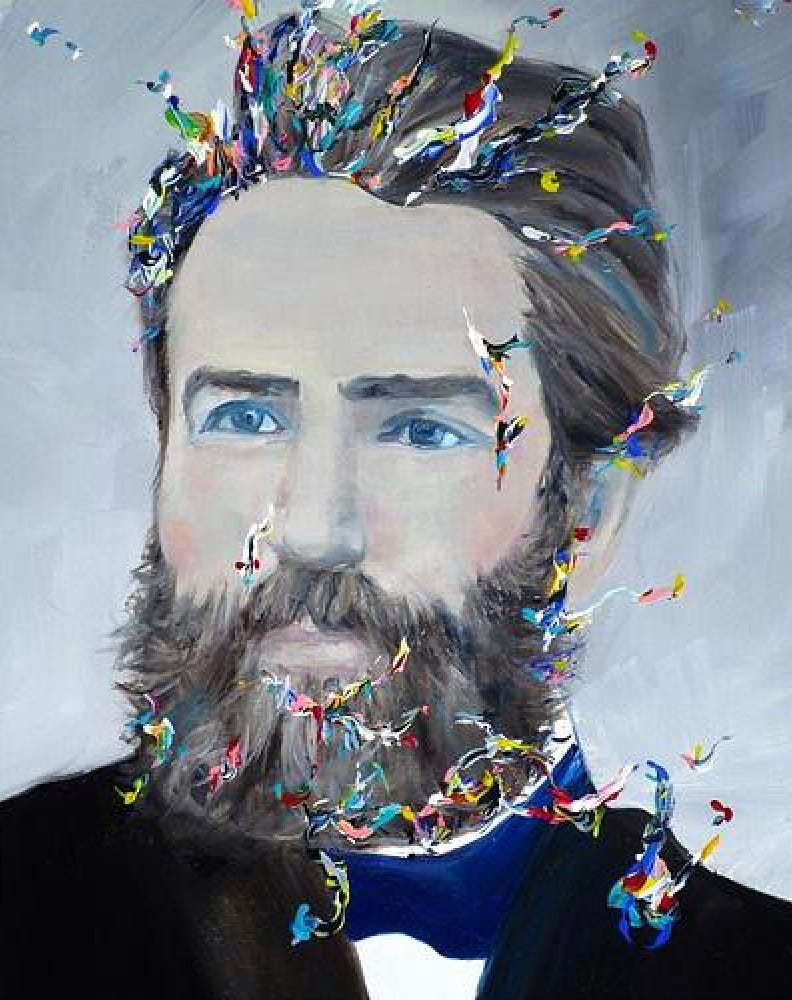
(Above: Portrait of Herman Melville by Fabrizio Lautir.)
I found Melville’s photographic portraits were all rather stern with a stony countenance cut ironically into the handsome seafaring author’s face (nautical lexicon already homonymously landing back there nine words in) when I went looking for a photo of him caught off-guard with perhaps a lopsided grin which he might have described as broad-on-the-bow, green-lit, employing such lexicon himself inside his sense of language as something to be unfurled, that flapped, ahoo, then there, ahead, not aft, not nine-words-in, not back toward comprehension but continuing on toward something submerged, a plot, where narrative revelations in his beloved natural realm of men and all that aren’t convince any deeper authorial confession to remain muted in its own bloody mammal warmth. Like all of life before all that isn’t befalls us, it is bluster in the service of silence.
Moby-Dick’s discursive - at times, for me, unfathomable - brilliance does make room for some declarative joy. “I know not all that may be coming, but be it what it will, I’ll go to it laughing,” Melville famously wrote within its pages. And this: “However, a good laugh is a mighty good thing, and rather too scarce a good thing; the more’s the pity. So, if any one man, in his own proper person, afford stuff for a good joke to anybody, let him not be backward, but let him cheerfully allow himself to spend and to be spent in that way. And the man that has anything bountifully laughable about him, be sure there is more in that man than you perhaps think for.”
His follow-up novel to Moby-Dick; or, The Whale was the even more critically disdained at the time, Pierre; or, The Ambiguities. Unlike Ishmael and Queequeg, who had a quite fathomable homosexual attraction and relationship in Moby-Dick that didn’t just border on the shipboard but landed them in bed together in dockside scenes, the title character in that next novel matched the sexual ambiguity of its author’s own. Maybe this line from that book is why it’s so hard to find a smiling photo of Melville: “A smile is the chosen vehicle of all ambiguities.” The sexually ambiguous usually … well … let’s face it … aren’t. Not really. I was once on a New York City bus eavesdropping on two elderly ladies. “I’m worried about Ira,” said one to the other. “He doesn’t like girls and he doesn’t like boys.” The other replied, patting her friend’s knee: “Hmm … he doesn’t like girls and he doesn’t like boys. He likes boys, dear.”
Scholars and historians have debated that same worry they’ve had about Melville because of the epistolary trail he left concerning his regard for Nathaniel Hawthorne for whom he moved upstate so he could be nearby him and more than neighbourly. Although Melville was married for over 40 years and Hawthorne for over 20, many have considered Hawthorne the great love of his life. That regard for his fellow writer did have the male musk of romance about it. Melville’s fictional work is certainly filled with homoeroticism; it is indeed redolent of it, that musk, its maleness. It seemed to have revved him up, the homoerotic, to embark on those sentences that sail forth with that particular angle, that needed slant upwind of it.
Bruce LaBruce at his Facebook page cited in a post a few revved-up sentences Melville wrote about Hawthorne and to him which are filled with a visceral overwrought abandon that has the mad kind of joy of someone a bit too mindful of their manner and the matter at hand. “A man of a deep and noble nature had seized me in this seclusion,” he wrote in a journal entry. “The soft ravishments of the man spun me round about in a web of dreams. . . . But already I feel that Hawthorne had dropped germinous seeds into my soul. He expands and deepens down, the more I contemplate him; and further and further shoots his strong New-England roots into the hot soil in my Southern soul.”
And these are excerpts from letters he wrote to him:
“If ever, my dear Hawthorne, in the eternal times that are to come, you and I shall sit down in Paradise, in some little shady corner by ourselves; and if we shall by any means be able to smuggle a basket of champagne there (I won’t believe in a Temperance Heaven), and if we shall then cross our celestial legs in the celestial grass that is forever tropical, and strike our glasses and our heads together, till both musically ring in concert, – then, O my dear fellow-mortal, how shall we pleasantly discourse of all the things manifold which now so distress us … The divine magnet is on you, and my magnet responds. Which is the bigger? A foolish question – they are One.”
I love doing these deep dives of research that are part of my finding the three rungs on a RUBRICS ladder when I post one of the columns in this series. I was deep in the blissful research dive for this one when I happened upon the entry below in a blog which is based on another epistolary trail, this one left by a father, Don Dickson, in his weekly letters over a 29-year span to his children. They were discovered boxed and stored away by a son, John, who edited them into a collection called Have a Great Week, Love!, which was how his father signed all those letters over the years. Below is an excerpt that captures both the joy of Don, who was a Melville aficionado, as well as that of the 19th century American author himself. This entry is titled “Summer with Herman Melville.”
The excerpt:
“August 14
“When Herman Met Nathaniel
“Not exactly Harry and Sally, but a milestone in American literary history. And, it might make an even more compelling film; not a comedy, but quite possibly a romance.
“August 5, 1850. In the Berkshires, on his summer retreat, Herman Melville accepted the invitation from a New York lawyer by the name of David Dudley Field to join a group of writers for a hike up Monument Mountain. Melville was just 31 and had 4 popularly acclaimed books published, each recounting different adventures at sea, in the Polynesian Islands, in the North Atlantic, on a naval vessel. He had a draft of a fifth book with him, about a whale.
“Field had invited another recent arrival in the Berkshires, Nathaniel Hawthorne. Fifteen years older than Melville, Hawthorne had moved to a cottage in Lenox, to escape the fallout in his hometown of his new book, The Scarlet Letter. As happens on hikes like this, people who don’t know each other end up talking with the hikers on either side of them. Hikers re-group after breaks and find themselves next to different people, and strike up a new conversation, perhaps even a new friendship.
“This is what we did when a group of 25 of us walked in the footsteps up Monument Mountain on the anniversary of the hike, and as part of an annual commemoration of Melville’s August 1 birthplace organized each year by the Berkshire Historical Society. It is also, undoubtedly, how Herman met Nathaniel.
“Various accounts of the hike corroborate that Melville captured everyone’s attention. In a state of high exuberance, Melville ran to the edge of the cliffs in the middle of a storm, demonstrating with flinging arms how he would handle at sea the fierce winds atop the rigging of the masts. The one word which repeatedly comes up in describing Hawthorne is reticent, so Melville’s antics must have registered. Given the fast friendship which developed, they did not have the reverse effect of alienating Hawthorne. He must have seen an intellect and a sense for drama which attracted him.
“The speed with which a friendship developed was reflected in Melville’s spontaneous decision to move to the area. By September he bought the house he called Arrowhead, which offered him inspiring views that reminded him of being at sea, and an inspiring proximity to Hawthorne. Over the next few months, the two would spend much time together, huddled in deep, extended conversations about writing, about philosophy and life’s meaning, and what comes after life.
“The discussions changed Melville’s approach to his book on the whale, which he re-wrote in his first year at Arrowhead. Melville said he decided to write the way he wanted, instead of what he knew his audience and his editors wanted. Hawthorne brought out the darkness, the conflict, the narrative of what would become perhaps most well-known (but not well or easily read) conflict in American literature, between Captain Ahab and Moby Dick. Hawthorne’s influence on Moby Dick is acknowledged in Melville’s dedicating the epic novel to him.
“The language of the letters Melville and Hawthorne exchanged has left some to conclude that this might have been more than just two writers discussing their work. Melville expresses his attachment to his mentor in words of love, and probably not just by our current century’s sensibilities:
“‘your heart beat in my ribs and mine in yours, and both in God’s. . . . Whence come you, Hawthorne? By what right do you drink from my flagon of life? And when I put it to my lips—lo, they are yours and not mine.’
“Our guide on the day of the hike this year noted that he had often thought of writing a screenplay about the meeting and the subsequent relationship, but added ‘that it might have to be X-rated.’
“Our hike on August 3, 2013 inevitably was not a strict re-enactment. We arrived in automobiles at the foot of Monument Mountain, and while we also carried champagne to the summit and read the poem by William Cullen Bryant about the monument to the Indian maiden who leapt from the mountain, we had a clear day to see across to New York and possibly past Mt. Greylock to Vermont.
“Our companions whom we got to know included several Melville scholars and members of the 600-person strong Melville Society, but also historians and writers and even a young man about to leave to start his career as a Hollywood stunt artist. We didn’t think of asking him to go out on a ledge and how to haul in a sail in the middle of a storm.”
[TO VIEW AND READ ABOUT THE REMAINING RUBRICS THIS WEEKEND, JOIN OUR PAID SUBSCRIBER COMMUNITY FOR ONLY $5 A MONTH OR $50 A YEAR. IT MEANS A LOT. THANK YOU.]